How to Play UNO Championship Series
UNO Championship Series takes the familiar gameplay of UNO and turns it into a multi-round tournament. Instead of playing a single game and counting traditional UNO points, players compete for finishing positions over several rounds. Special rules are introduced along the way, and the best-performing players eventually advance to a final showdown to determine the UNO Champion.
The UNO Championship Series Expanded Tournament Set is designed for 6 to 30 players. It includes three UNO decks, 12 special rule cards, leaderboards, dry-erase markers, and a championship trophy. The three decks allow games to be played simultaneously at up to three tables.
UNO Championship Series Video Tutorial
DISCLAIMER: This page contains affiliate links, which means that if you click on one of the product links, I’ll receive a small commission at no extra cost to you. Thank you for your support!
Objective
The object of UNO Championship Series is to perform well enough during the preliminary rounds to advance to the Final Round, then be the first finalist to get rid of all the cards in your hand.
During the preliminary rounds, players are ranked based on how quickly they get rid of their cards. A first-place finish is best, so lower placement scores are better.
Setup
UNO Championship Series can be played at one, two, or three tables depending on the number of players. Divide the players as evenly as possible between the tables and give each table one UNO deck.
The three decks have different colored backs, making it easier to keep the cards from each table separated.
Choose a dealer at each table. Shuffle the deck and deal seven cards face down to each player. Players can look at their own cards but should keep them hidden from the other players.
Place the remaining cards face down in the middle of the table to form the draw pile. Flip the top card face up beside it to begin the discard pile.
The player to the left of the dealer goes first, with play initially moving clockwise.
Shuffle the 12 special rule cards and randomly select two special rules for the round. Place them where everyone can see them. These rules remain active for the entire round and change when the next round begins.
How to Play UNO Championship Series
On your turn, play one card from your hand that matches the top card of the discard pile by color, number, or symbol.
For example, if the top card is a red 5, you could play:
Any red card
A 5 of any color
A Wild card
If you cannot play a card, draw one card from the draw pile. If the drawn card can be played, you may play it immediately. Otherwise, add it to your hand and your turn ends.
Play continues around the table until one player gets rid of all the cards in their hand.
UNO Action Cards
The normal UNO action cards work as expected unless one of the Championship Series special rules changes their effect for the current round.
Draw Two
When a Draw Two card is played, the next player must draw two cards and loses their turn.
Reverse
A Reverse card changes the direction of play. If play was moving clockwise, it will now move counterclockwise, and vice versa.
Skip
A Skip card causes the next player in the current direction of play to lose their turn.
Wild
A Wild card can be played regardless of the card currently on top of the discard pile. The player who plays it chooses the color that continues play.
Wild Draw Four
A Wild Draw Four allows the player to choose the next color and forces the next player to draw four cards and lose their turn.
The Wild Draw Four can only be played when you do not have a card matching the current color.
Special Championship Rules
The biggest difference between regular UNO and UNO Championship Series is the addition of special rules that change from round to round.
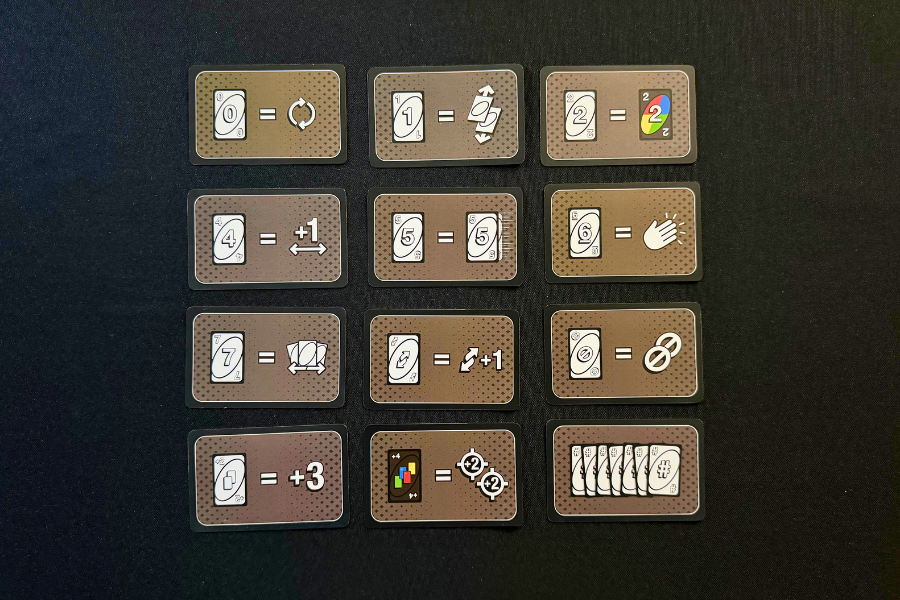
The Expanded Tournament Set includes 12 special rule cards. At the beginning of each round, two are randomly selected and placed where everyone can see them. These rules change the way certain number or action cards work for that entire round.
The 12 special rules are:
0 – Pass Hands: When you play a 0, every player passes their entire hand to the next player in the current direction of play.
1 – Swap a Card: When you play a 1, you may exchange one card from your hand with one card from another player's hand.
2 – Deuces Wild: Number 2 cards can be played as Wild cards, allowing you to change the color in play.
4 – Draw on Both Sides: When you play a 4, both the player to your left and the player to your right must draw one card. Play then continues with the next player in the current direction of play.
5 – Jump In: If you're quick, you can play a 5 out of turn. The 5 must match the color of the card currently on top of the discard pile. Play then continues from your position.
6 – Slap the Deck: Playing a 6 activates the Slap the Deck rule, causing players to race to slap the discard pile.
7 – Trade Hands: When you play a 7, you may trade your entire hand with another player.
Reverse Draw One: Reverse cards still change the direction of play but also add a Draw One effect.
Double Skip: Instead of skipping one player, a Skip card causes the next two players in the current direction of play to lose their turns.
Draw Three: Draw Two cards become Draw Three cards, forcing the affected player to draw three cards instead of two.
Wild Double Target: When playing a Wild Draw Four, the four-card penalty can be divided between two opponents.
Number Stack: When you play a numbered card, you may also play any other cards of the same number from your hand at the same time as a single play.
Because only two special rules are active during each round, the importance of different cards can change significantly from one game to the next. A 5 might be an ordinary number card in one round and suddenly allow you to jump into play during the next.
Always review the two selected rule cards before beginning the round. When a special rule changes the effect of a card, follow the Championship rule instead of that card's normal effect.
Calling UNO
Whenever you play your second-to-last card, you must call out “UNO!” to let everyone know you have only one card remaining.
If another player catches you failing to say UNO before the next player begins their turn, you must draw two cards.
If no one catches you in time, there is no penalty.
Ending a Round
Unlike traditional UNO scoring, you do not continue playing after someone gets rid of their final card.
As soon as one player plays their last card, the round immediately ends.
That player receives 1st place for the round.
The remaining players are then ranked according to the number of cards still in their hands. The player with the fewest remaining cards receives the next-highest position, followed by the player with the next fewest cards, and so on.
For example, suppose a five-player table ends with:
Alex – 0 cards
Jamie – 2 cards
Chris – 3 cards
Taylor – 5 cards
Morgan – 7 cards
The finishing positions would be:
Alex
Jamie
Chris
Taylor
Morgan
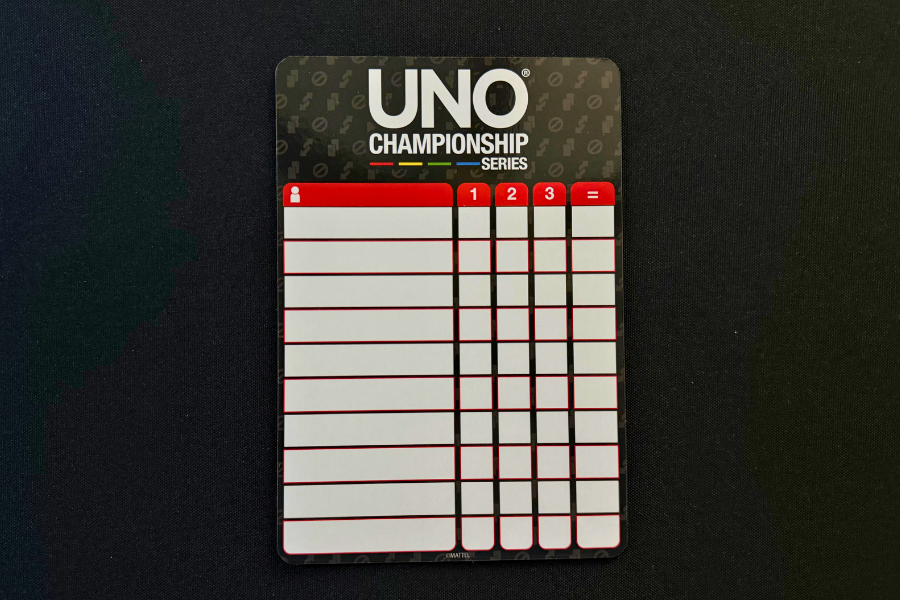
Record each player's finishing position on the Championship leaderboard.
Each table keeps track of its own standings throughout the preliminary rounds.
Starting the Next Round
Shuffle the cards and prepare for another round.
Return the previous special rule cards and randomly select two new special rules. Players then begin another game of UNO using the new combination of rules.
UNO Championship Series uses three preliminary rounds before determining who advances to the Final Round.
After each round, record every player's finishing position on the leaderboard.
Championship Series Scoring
After all three preliminary rounds have been completed, add together each player's finishing positions.
For example, a player who finishes:
Round 1: 2nd
Round 2: 4th
Round 3: 1st
would have a tournament score of:
2 + 4 + 1 = 7
Remember that lower scores are better.
A player consistently finishing near the top of the table will therefore have a much better tournament score than someone regularly finishing near the bottom.
The players with the lowest tournament scores advance from each table to the Final Round.
When using all three decks and three tables, the top two players from each table advance, creating a six-player Final Round.
With fewer tables, the Final Round will have fewer players:
One table: 2 finalists
Two tables: 4 finalists
Three tables: 6 finalists
Move the qualifying players to the Final Round section of the leaderboard.
The Final Round
Bring all of the qualifying players together at one table.
Set up one UNO deck for another game and select the special rules that will be used for the final.
Unlike the preliminary rounds, there is no need to calculate another tournament score.
This time, everything comes down to one game.
The first player to successfully play their final card wins the Final Round and becomes the UNO Champion!
Award the Championship trophy to the winner.
UNO Championship Series Strategy
Because tournament standings are based on finishing position rather than the traditional point values of the cards remaining in your hand, your strategy can change.
Getting rid of cards is always important, even if it looks unlikely that you will win the round.
If another player appears ready to go out, reducing your hand from six cards to three before the round ends could mean the difference between finishing second and finishing fifth.
The changing special rules are also important. Before every round, take a moment to think about which cards have become more valuable. A normally harmless number card may suddenly allow you to trade hands, swap a card, or trigger another powerful effect.
Finally, keep track of the tournament standings. A player who has already earned two strong finishes may prefer safer plays, while someone near the bottom of the leaderboard might need to take more chances in the third preliminary round.
UNO Championship Series vs. Regular UNO
The actual card play will feel familiar to anyone who already knows UNO. The major differences are the tournament structure and changing rules.
Regular UNO is generally focused on winning individual hands and accumulating points. UNO Championship Series instead emphasizes finishing position across several games.
The Championship Series also allows a much larger group to compete at the same time. Rather than putting 20 or 30 people around one enormous UNO game, players are separated across multiple tables and compete through the same three-round tournament structure.
The special rule cards make each round feel different as well. You may understand exactly how the cards work in one round only to have two new rules change your strategy in the next.
That combination makes Championship Series particularly well suited for a larger game night where you want UNO to feel more like an organized competition than a single casual game.
Gather Together with UNO Championship Series
UNO Championship Series takes a game nearly everyone already knows and gives it a fun tournament-night feel.
The familiar color and number matching keeps the game easy to jump into, while changing special rules, round-by-round standings, and a final championship match give everyone something to play for.
Gather your group, keep an eye on the leaderboard, and see who can claim the trophy as the ultimate UNO Champion!