How To Play 3 Player Chess
Three player chess takes the familiar rules and pieces of traditional chess and adds a third player to the battle. Instead of focusing on a single opponent, players must defend against attacks from two directions while deciding when to attack, when to hold back, and sometimes when to let the other two players fight each other.
There are several versions of three player chess, with different boards and slightly different rules. This guide focuses on the common version played on a hexagonal-shaped board made up of 96 spaces, with each player controlling a standard set of 16 chess pieces.
3 Player Chess Video Tutorial
What You Need to Play 3 Player Chess
To play, you will need:
Three sets of chess pieces in different colors
Three players
Each player gets the same 16 pieces used in traditional chess:
1 King
1 Queen
2 Rooks
2 Bishops
2 Knights
8 Pawns
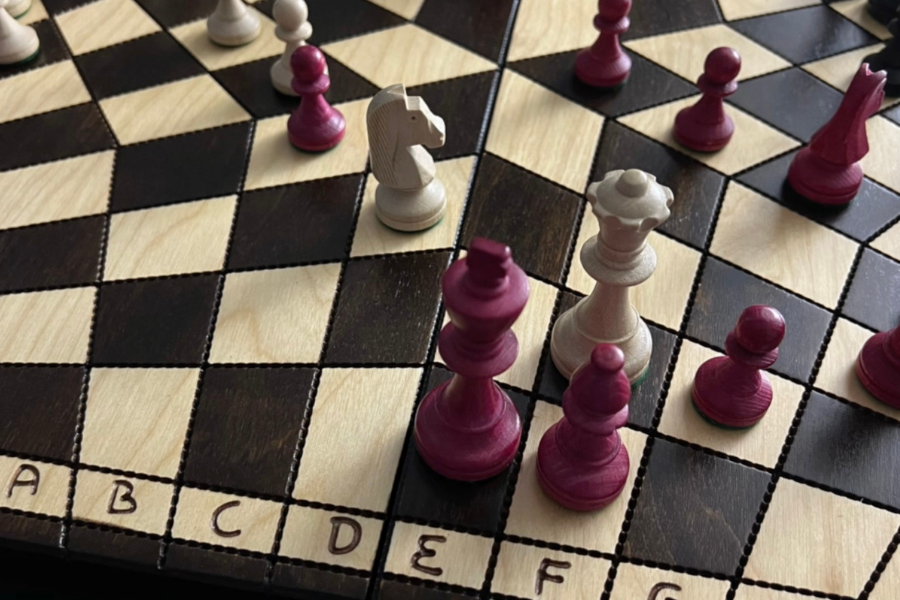
The board is divided into three sections, giving each player their own starting area.
Setting Up 3 Player Chess
Each player chooses a color and sits behind one side of the board.
Set up your pieces in the two rows closest to you. The eight pawns are placed across the second row, with the remaining pieces placed along the back row in the same basic arrangement used in regular chess.
Once all three armies are in position, decide which player will move first. The exact starting color can vary depending on the version of three player chess being played. On some common sets, Red moves first, followed clockwise by White and then Black. Other versions use a different starting order.
After the starting player takes a turn, play continues clockwise around the board.
Objective of 3 Player Chess
The objective is to checkmate an opponent's king while preventing either opponent from checkmating yours.
This is where three player chess becomes very different strategically from traditional chess. You are not simply playing two separate chess games at the same time. Every move can affect all three players.
An attack against one opponent might leave you exposed to the other. You may also find yourself temporarily benefiting from another player's move even though that player is still your opponent.
Because multiple versions of three player chess exist, players should agree before beginning what happens after the first checkmate. A common rule ends the game as soon as one player delivers checkmate, while other versions eliminate the checkmated player and allow the remaining two players to continue.
How to Play 3 Player Chess
On your turn, move one of your pieces.
Most pieces move according to the same basic rules as traditional chess. Pieces cannot move through another piece unless they are a knight, and moving onto a space occupied by an opponent's piece captures and removes that piece.
The unusual shape of the board becomes most important when pieces reach the center. Lines that appear to bend around the center are still considered continuous movement paths. This allows pieces to move from one player's section of the board into another.
Pawns
Pawns move forward one space at a time toward the center of the board. On a pawn's first move, it may move two spaces if both spaces are open.
Pawns capture one space diagonally forward.
Once a pawn passes through the center of the board, its forward direction continues toward an opponent's side of the board rather than turning toward another section.
Pawn promotion works similarly to normal chess when a pawn successfully reaches an opponent's back rank.
Rooks
Rooks move any number of open spaces horizontally or vertically.
When a rook's movement reaches the center of the board, follow the lines printed on the board to determine how its path continues. Although the path may appear to bend because of the board's shape, it is still treated as a straight rook movement.
Bishops
Bishops move diagonally across any number of open spaces.
A bishop stays on the same color spaces throughout its move, just as it does in traditional chess. When a diagonal reaches the center of the board, there may be more than one path available for the bishop to follow.
Knights
Knights continue to move in an L-shaped pattern: two spaces in one direction followed by one space in a perpendicular direction.
They are also still the only pieces that can jump over other pieces.
Because of the unusual geometry near the middle of the three player chess board, a knight positioned near the center can sometimes have more possible destinations than it would on a regular chessboard.
Queen
The queen combines the movement of a rook and bishop.
It can move any number of open spaces horizontally, vertically, or diagonally. When crossing through the center, follow the appropriate rook or bishop movement lines on the board.
King
The king can move one space horizontally, vertically, or diagonally.
As in regular chess, a king cannot legally move onto a space where it would be under attack by another player's piece.
The king must be protected from both opponents, which makes king safety especially important in three player chess.
Check and Checkmate
A king is in check whenever it is threatened with capture by an opponent's piece.
If your king is in check when your turn begins, you must make a legal move that removes the threat. This might mean moving the king, capturing the attacking piece, or blocking the attack.
A checkmate occurs when a king is in check and there is no legal way to escape.
The presence of a third player can create unusual situations. For example, one player's move could uncover an attack from the third player's piece.
What Happens After a Player Is Checkmated?
This is one rule you should establish before beginning because different three player chess sets use different systems.
One simple version ends the game immediately. The player who delivers the first checkmate wins.
Another version eliminates the checkmated player and leaves their remaining pieces on the board as inactive pieces. The other two players then continue until one player remains.
A third variation gives control of the defeated player's remaining pieces to the player who delivered the checkmate.
Strategy for 3 Player Chess
Three player chess requires a different mindset than regular chess.
Attacking aggressively isn't always the best option. If you trade several pieces with one opponent, the third player may benefit without losing anything.
It is also important to watch the entire board. A move that looks strong against the player directly across from you could open a rook, bishop, or queen attack from the player sitting beside you.
Sometimes the best move is simply to improve your position while allowing the other two players to attack each other.
Temporary cooperation can also occur naturally. Two players may both benefit from stopping the third player from gaining a major advantage. Just remember that there are no permanent teams. Every player is ultimately trying to win.
How Is 3 Player Chess Different From Regular Chess?
Most of the basic chess rules remain familiar. The pieces have recognizable movements, players capture opposing pieces, kings can be placed in check, and checkmate remains the central goal.
The biggest differences come from the board and the third player.
Movement paths change as pieces cross through the center, attacks can come from multiple directions, and every move must account for two opponents instead of one. Even players who are very comfortable with traditional chess will need some time to adjust to the new board.
That extra layer of strategy is what makes three player chess such an interesting variation of the classic game.
Gather Together with 3 Player Chess
Three player chess is a great way to put a new spin on a familiar strategy game. Most of the traditional pieces and movements remain intact, but adding another army completely changes how players approach attacking, defending, and protecting their king.
Once you become comfortable following the movement lines through the center of the board, you can focus less on the unusual layout and more on the challenge of outmaneuvering two opponents at once.
DISCLAIMER: This page contains affiliate links, which means that if you click on one of the product links, I’ll receive a small commission at no extra cost to you. Thank you for your support!