How To Play Senet
Senet is an ancient Egyptian board game for two players. Players race their pieces around the board while trying to slow down their opponent and be the first to remove all of their pieces from play.
Senet Video Tutorial
What You Need
To play Senet, you need:
A Senet board with 30 spaces
Five playing pieces for each player
Four throwing sticks
A standard six-sided die can also be used in place of the throwing sticks. If using a die, reroll any 5s.
Objective
The goal of Senet is to move all five of your pieces around the board and bear them off before your opponent does.
The first player to remove all five of their pieces wins the game.
Setup
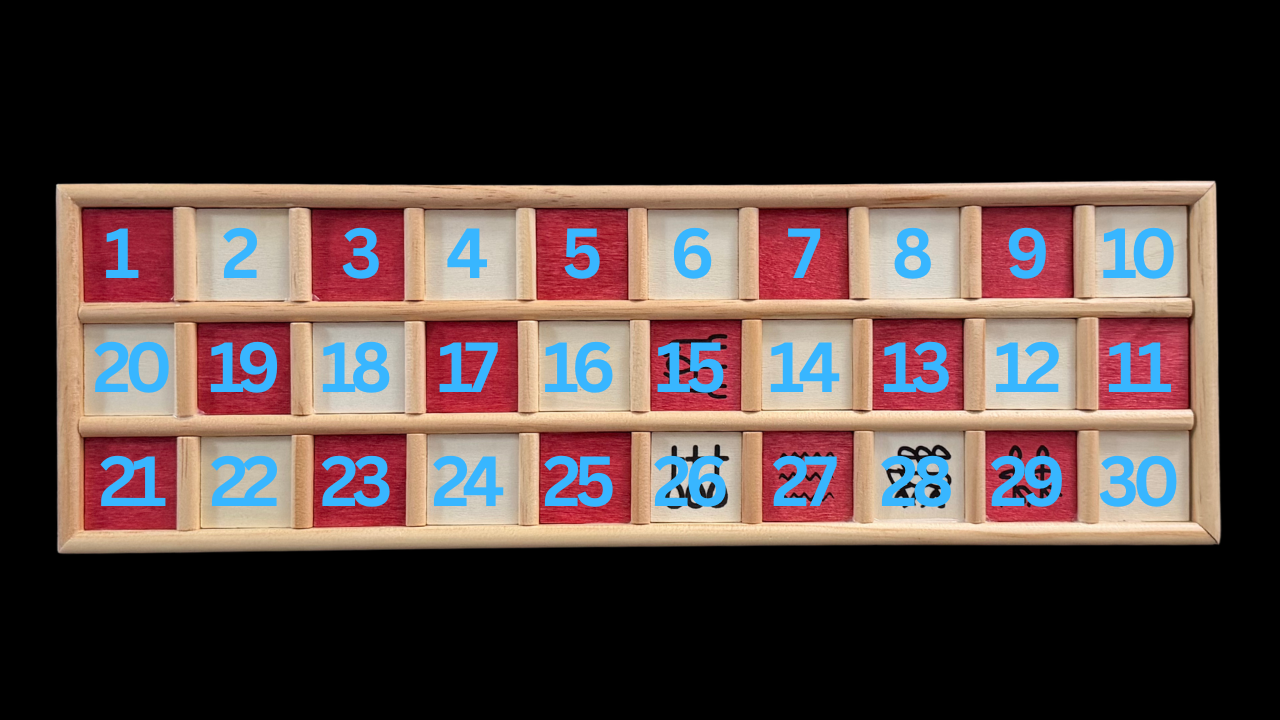
Number the spaces on the board from 1 to 30.
Spaces 1 through 10 make up the first row, spaces 11 through 20 make up the second row, and spaces 21 through 30 make up the final row.
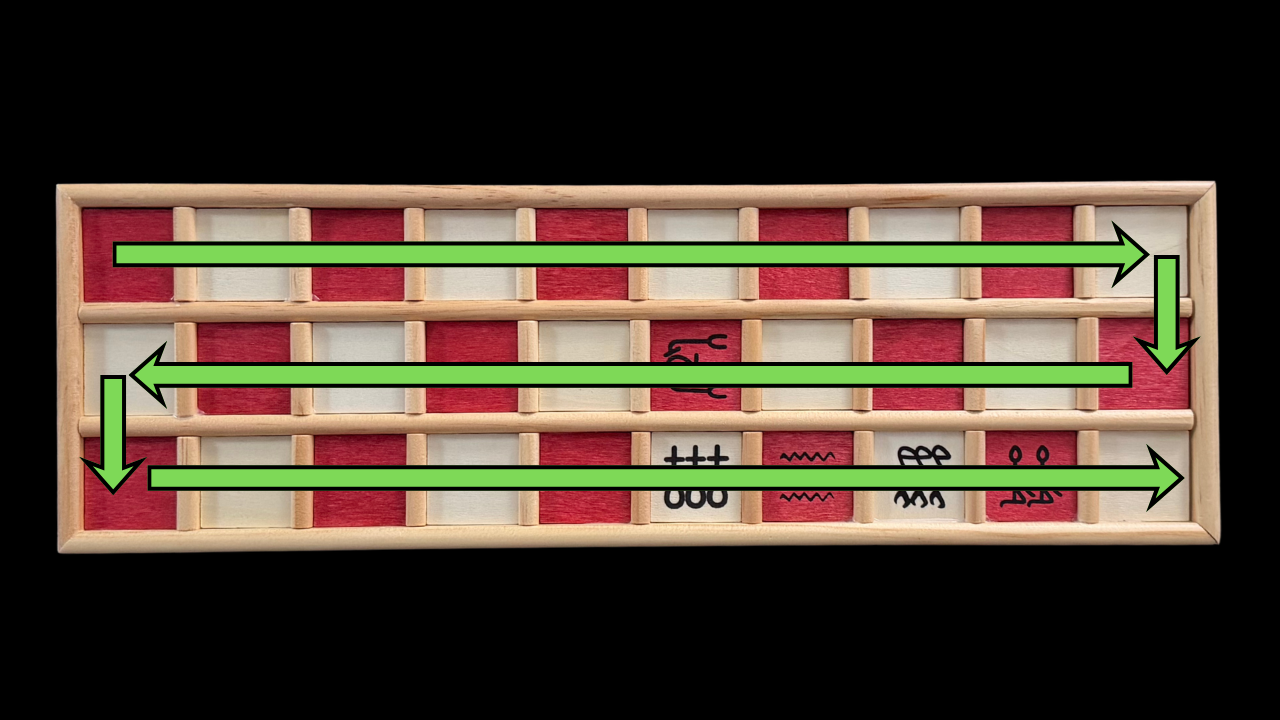
The direction of movement follows a winding path:
Move across the first row from spaces 1 through 10.
Move back across the second row from spaces 11 through 20.
Move across the final row from spaces 21 through 30.
Place the ten playing pieces on spaces 1 through 10, alternating between the two players.
One player occupies the odd-numbered spaces and the other occupies the even-numbered spaces.
Using the Throwing Sticks
The four throwing sticks each have one flat side and one rounded side.
Throw all four sticks together and count the number of flat sides that land face up.
The result is determined as follows:
One flat side up = 1
Two flat sides up = 2
Three flat sides up = 3
Four flat sides up = 4
Four rounded sides up = 6
There is no result of 5.
Starting the Game
To determine who moves first, players take turns throwing the sticks until someone throws a 1.
That player uses the piece beginning on space 10 and moves it to space 11.
The same player throws again.
Whenever a player throws a 1, 4, or 6, they move a piece and then throw again.
Whenever a player throws a 2 or 3, they move a piece and their turn ends.
The second player's first move must be made with the piece beginning on space 9. After that first move, the player may move any eligible piece.
Moving Pieces
On your turn, move one of your pieces forward the exact number of spaces shown by your throw.
Pieces follow the numbered path from space 1 toward space 30.
You cannot land on a space occupied by one of your own pieces.
If your piece lands on a space occupied by an opponent's piece, the two pieces exchange positions.
The opponent's piece moves back to the space your piece just left.
Protected Pieces
Two pieces belonging to the same player that occupy consecutive spaces protect each other.
Protected pieces cannot be attacked and swapped by an opponent.
Three pieces of the same color in consecutive spaces form a block.
A block cannot be attacked, and opposing pieces cannot move through it.
Pieces belonging to the player who created the block may still move through their own block normally.
Moving Backward
If you cannot make a legal forward move using your throw, you must move a piece backward by the amount shown instead.
If the backward move lands on an opponent's unprotected piece, the two pieces exchange positions just as they would during a forward move.
If you cannot make a legal move either forward or backward, your turn ends.
Special Spaces
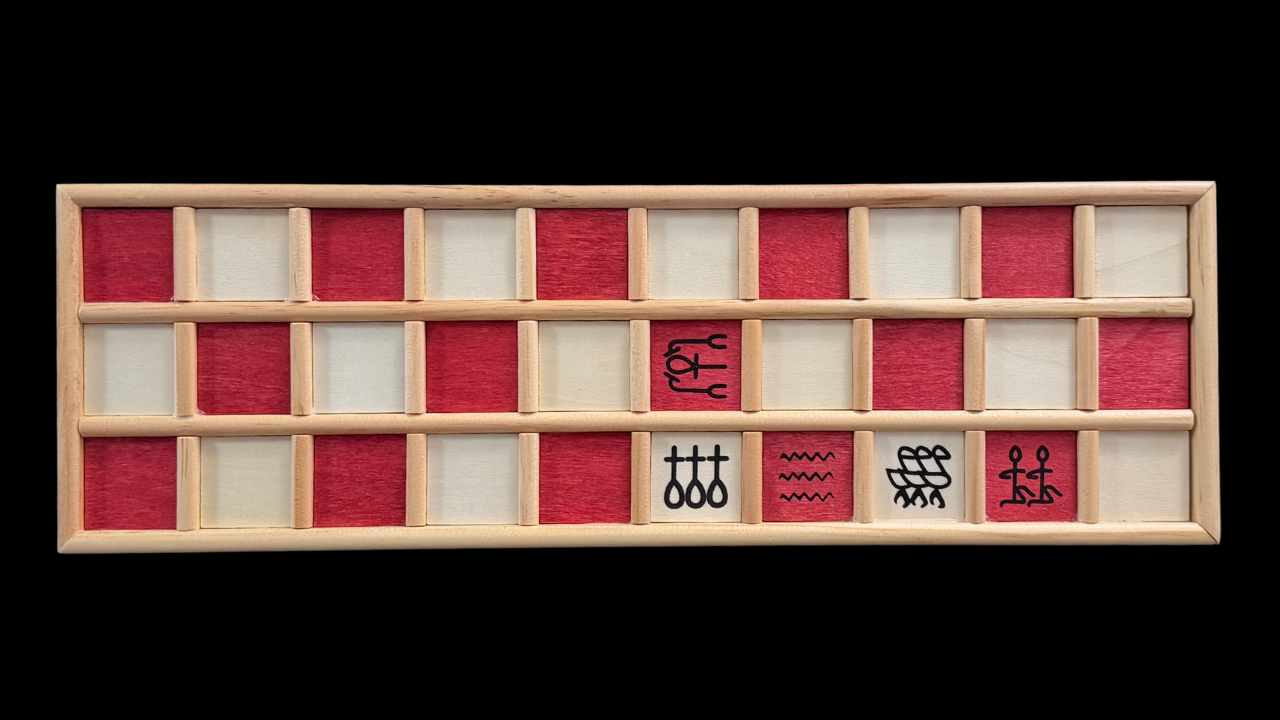
Several spaces near the end of the board have special rules.
Space 26
Space 26 is a safe space.
A piece on this space cannot be attacked by an opponent.
Space 27
Space 27 is the water or trap space.
Any piece that lands on space 27 must immediately return to space 15.
If space 15 is occupied, the piece instead returns to the beginning of the board and must work its way around again.
Spaces 28 and 29
Spaces 28 and 29 are also safe spaces.
Pieces occupying these spaces cannot be attacked.
A player may remain on a safe space unless they choose to move the piece.
Bearing Off
Once all five of your pieces have moved out of the first row, you may begin bearing pieces off the board.
A piece does not have to land exactly on space 30 before being removed.
If your throw is larger than the number needed to bear off a piece, the unused portion of the throw may be used to move another piece.
For example, if a piece needs only two spaces to leave the board and you throw a 4, you may use the remaining two spaces to move another piece.
If one of your pieces is attacked and sent back into the first row, pieces still in the third row cannot be borne off until all of your pieces have once again left the first row.
Winning the Game
The first player to bear all five of their pieces off the board wins.
If you are playing several games and want to keep score, you can use the following scoring system:
1 point for every opposing piece remaining in the third row
3 points for every opposing piece remaining in the first or second row
Senet Strategy Tips
Although luck plays an important role in Senet, there are still several ways to improve your chances.
Try to keep pairs of pieces together whenever possible so they protect each other from attacks.
Creating a three-piece block can also make it difficult for your opponent to move through the board.
As you approach the final spaces, pay close attention to space 27. Landing on the water space can send a piece far backward and dramatically change the game.
Finally, don't rush every piece toward the end individually. Maintaining protected groups can sometimes be more valuable than moving one piece several spaces ahead.
Senet combines racing, blocking, attacking, and luck into a simple game that can change quickly from one turn to the next. The first player to successfully navigate the board and bear off all five pieces wins.
DISCLAIMER: This page contains affiliate links, which means that if you click on one of the product links, I’ll receive a small commission at no extra cost to you. Thank you for your support!